Common Purpose and Our Role in London’s Journey to Net Zero

Architects play a critical role in shaping cities that are as sustainable, inclusive and resilient as they are functional and beautiful. As London accelerates its journey toward Net Zero in 2030, the path forward demands more than technical solutions—it requires leadership, innovation and meaningful collaboration across sectors.
In line with this ethos, Mailen Design recently participated in Common Purpose UK’s ‘Leading Beyond Boundaries’ programme, with Director Jon Humphreys invited to speak as part of an immersive workshop exploring the question: “How can we work together to transform London into a cleaner, greener, climate-positive city for existing and future citizens?”
The programme, designed to help develop senior leaders through real-world engagement, brought together diverse professionals to explore the power of cross-sector partnerships and lateral thinking in addressing one of the most urgent challenges of our time. Whilst the workshop itself was just one part of a broader development initiative, it provided a vital space to reflect on the social value of architecture and the role of built environment professionals in leading systemic change.
BRINGING CLIMATE LEADERSHIP TO THE FORE
Mailen Design’s engagement with Common Purpose reflects our commitment to design that responds to both global imperatives and local needs. As a practice, we consistently seek opportunities to contribute to the climate agenda, not only through the performance of our buildings but through the way we lead, collaborate and advocate for change.
The conversation Jon shared with participants focused on the value of the built environment in achieving net-zero goals and fostering equitable outcomes. Insights from our practice, including how we approach sustainability across retrofit and new-build projects in a variety of sectors, contributed to a broader dialogue over two days that explored what climate leadership looks like in a complex urban context.
DESIGNING FOR A CLIMATE-POSITIVE LONDON
From neighbourhood housing schemes to landmark retrofit projects, our portfolio reflects a longstanding focus on sustainable outcomes. A number of recent projects offer practical examples of how we are contributing to a cleaner and greener capital.
At Domus Campus, we transformed a cluster of outdated commercial buildings into a dynamic showroom and workplace hub through intelligent adaptive reuse. Retaining and reconfiguring the existing fabric not only reduced embodied carbon but also enabled us to create a flexible, multi-functional environment aligned with contemporary modes of working. Material innovation was central to the project, with reclaimed wood flooring and tiles made from recycled stone underscoring our low-carbon approach.
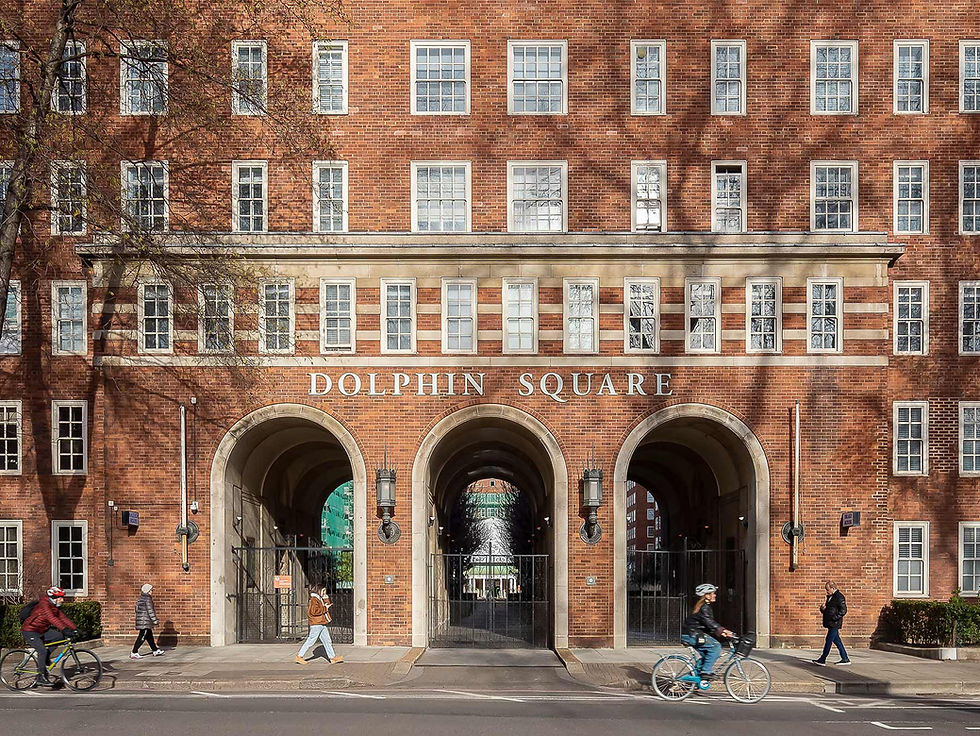
Our work at Dolphin Square, one of London’s most significant residential estates, is another case in point. With our retrofit of over 500 apartments and communal spaces now underway, we have introduced air source heat pumps, MVHR systems, and high-performance insulation, all while respecting the estate’s historic fabric. The project is a live example of our ability to deliver high-quality, low-carbon living at scale—and of the value we place on long-term stewardship of the built environment.
Elsewhere, projects such as Weald House and Lee Terrace show how contemporary homes can be embedded sensitively into their contexts whilst meeting ambitious energy targets. In each case, material selection, orientation, and envelope performance have been carefully calibrated to deliver homes that work with their environment, not against it.
LOOKING BEYOND BOUNDARIES
Participating in Common Purpose UK’s programme reaffirmed our belief that the most enduring solutions come from collaboration. As architects, we don’t work in isolation—we rely on partnerships, shared knowledge, and collective ambition to shape better outcomes. Whether leading multi-disciplinary teams or working alongside local communities, our goal is always to foster environments that are inclusive, resilient and future-focused.
As London seeks to become a truly climate-positive city, we believe that architectural practices must not only design sustainably but lead with purpose, embracing education, dialogue, and cooperation at every opportunity.